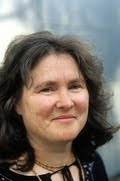
About Me

My photo
Victoria, Australia
I am an author of Young Adult Fiction books. I worked as a teacher in the Pacific Islands for seven years. Whilst in the Solomon Islands I taught PSSC English before the ethnic tension in 2000 forced a change of plans. I love Pacific literature, art and music. You can find me on Facebook at Beth Montgomery Author.

Wednesday, April 20, 2011

The Taniwha of Wellington Harbour by Moira Wairama

This book is just gorgeous, if you could call giant pre-historic monsters with detailed facial tattoos gorgeous. It tells the custom story of two taniwha (giant mythical sea creatures) that are good friends and live in a big lake at the bottom of the north island of New Zealand.
The Taniwha of Wellington Harbour (Penguin, 2011)
   One day one of the taniwha gets so bored that he decides to bash his way through the land to the nearby sea. His action creates what is now known as Wellington Harbour. The other taniwha mourns his loss and tries to swim out through the heads only to be stuck in the sand. The legend tells of a giant earthquake that unearths the stuck taniwha and heaves him ashore to become a hill overlooking the harbour.
   My daughter who is almost six was captivated by the illustrations in this book. The two sea monsters look something like dinosaurs or even dragons but the illustrator Bruce Potter has brought to life their emotions. We really empathised with the slower, sadder taniwha that was left behind.
   This is a lovely book for bed-time reading for your children.

Friday, April 15, 2011

Dangerous Love by Ben Okri

Dangerous Love is an African romance and I've decided to review it because it's one of those world books with 'mana' that are often overlooked in favour of English or American love stories. I don't normally enjoy romance novels so when I picked this book up I was half-hearted about it. It didn't take me long to be totally captivated and it's now one of my top-ten-best-ever reads.

Dangerous Love (Phoenix House, 1996)

   This is a tragic love story set in Nigeria in the 1970s just after the civil war. A young artist called Omovo falls in love with a woman who is trapped in a loveless arranged marriage. The husband's fury at her betrayl threatens their affair but poverty and illness impact upon their love too.
   The imagery in this novel is raw and tangible. The reader can hear and smell and taste the dusty city streets. I read this book more than ten years ago but I can still imagine the heroine in her yellow dress at the street party and the grime on the walls of the compound's communal bathroom.  I have since read other works by Ben Okri but this one remains my favourite.
    It isn't a book suitable for younger readers but I'm sure PSSC students could give it a try and enjoy it.

Sunday, April 10, 2011

Study notes: The short story

When preparing for PSSC exams it always pays to know at least two short stories so well that you can write about them easily. Alan Paton's 'The Waste Land' is a terrific story to keep in mind because it's so short but also because it's so powerful.
   The story opens with a middle-aged man stepping off a bus at night and sensing fear straight away. His fear is obvious as '...his mouth was already dry, his heart was pounding in his breast...' Fear is something we have all felt and so it's automatic that the reader instantly identifies with this man. The author uses the sound of the young men's approaching feet to raise the tension. The description of the bleak junk-yard setting also raises tension. There is no help for the man here, no chance of escape.
   Paton's describes panting, out-of-breath men so well that you can literally hear them. The reader squirms as the man struggles to silence his ragged breath as he hides from his pursuers. The twist at the climax of the story leaves the reader equally breathless as the tragedy reveals itself. If you haven't read this short story, you are missing out on a classic, one that will forever haunt you.

Wednesday, April 6, 2011

Island cabbage

I've recently been drafting a science worksheet to do with classification. Having a background in horticulture my mind always thinks of plant examples for these types of things. So what did I think of? Different types of cabbage.

   My husband calls silverbeet 'cabbage'. I've just been out to the garden to harvest some silverbeet for dinner. Whilst there I weeded some 'love-lies-bleeding'. It grows like a weed in our yard. We also eat the leaves occassionally and my husband also calls it cabbage. These 'pseudo cabbages' are very different to the cabbage he yearns for: which is 'slippery cabbage'. Unfortunately it doesn't grow in the cold down here at the bottom of Australia.
   Its botanical name is Abelmoschus manihot and it sure is slippery. When you cut the leaves a clear slime oozes out. Some people find the texture revolting but you get used to it, especially if there is no other green veg about. The amazing thing about it is that it has so many names throughout the Pacific: bele, pele, aibika, island cabbage, hibiscus cabbage and slippery cabbage. No wonder it's a good candidate for a classification exercise.

Friday, April 1, 2011

Green Boy by Susan Cooper

It's weird how I often read several books in a row that have a similar theme. Last week I finished a book about saving an island from development (Kaitangata Twitch). This week I picked up Green Boy by Susan Cooper thinking it would be another action-packed children's story set in the British Isles and maybe have something more to do with the old myths and legends of Merlin's time. If you haven't read The Dark is Rising sequence then that's what those books are about and I recommend them highly.


   I was happily surprised though to discover that Green Boy was a Carribean island story about Trey and her little brother Lou who is mute but very special. And guess what! They are trying to save their beloved Long Pond Cay from development.
   But that's where the similarities end because the children are somehow transported to another world in the future where development has taken over and not a single untouched forest remains. There are wilderness areas though, filled with dangerous mutant creatures and a ragtag bunch of protesters who are desperate to find Lou ahead of the ruling Government forces.
   Green Boy is an enjoyable read probably suitable for senior Primary School level. I liked Cooper's description of the beaches and the boats and the terror of the hurricane that hits Trey's village. Trey's relationship with her father is also handled well. I got a real sense of who Trey was and where her loyalties lay. If you enjoy speculative fiction then give this novel a try. 

Sunday, March 27, 2011

Kaitangata Twitch by Margaret Mahy

Kaitangata Twitch (Allen & Unwin, 2005)
New Zealander Margaret Mahy is a prolific children's writer who has won many awards. Kaitangata Twitch is another of her stories but perhaps not her best.
   The story is about Meredith Gallagher who is a dreamer and a sleep walker. There's Maori blood in her veins and she has a strong attachment to the little island of Kaitangita where the Maori people once practiced cannibalism. Meredith thinks the island is talking to her and when its wilderness is threatened by an unscrupulous developer Meredith and her family are compelled to fight for its preservation.
   This story was adapted for the screen and was recently shown as a miniseries on ABC TV. I never managed to see the series but I suspect it may have worked better than the book. I felt quite let down at the end of the story. The supernatural threat never seemed to be realised or was only alluded to, resulting in an anti-climax.
   I liked the way she drew her charcters though. Meredith and her family were very real and I think Mahy depicts the day to day interactions of her charcters beautifully.
   I think this book is a good one for junior readers because it's spooky but not so terrifying it will give you nightmares.

Wednesday, March 23, 2011

The Counting House by David Dabydeen

The Counting House isn't a book set in the Pacific but it is an island book of sorts. I read this novel a few years ago and was shocked by it's frank account of greed, manipulation and sexual abuse. Set in the 19th century the story revolves around the marriage of Indian couple Rohini and Vidia who migrate to the Carribean to work on a plantation. They are poor peasants who believe their life in British Guiana will bring them wealth and success. Their marriage falters as they struggle to make a new life in a strange land.

The Counting House

   As a group of characters I found everyone in the book repulsive. They all seemed obsessed with money and status. However Dabydeen has done a good job in depicting the characters' motivations and so I could understand their obsessions even if I couldn't sympathise with them. Issues of caste, slavery and racism are all dealt with in a confronting manner.
   If you like a book with a bit of sex and violence, then maybe this is for you. But I found the subject matter a bit too grim for my liking.

Sunday, March 20, 2011

Island hopping

The most economical way to get around island nations is on a ship, but oh boy what an experience! I think everyone who has lived in the islands has a horrendous boat story to tell. I know I have about four memorable trips etched into my brain, and one in particular where I was certain I would never make it back to the safety of Honiara.
   Boat travel is great material for your writing: all those smells, sounds, vibrations and the views of course.


My family on the Isabella (Source: B. Montgomery)

Travelling by ship, Solomons. (Source: B. Montgomery)


   Think about how sick you felt in the rocking waves, the diesel fumes, the throb of the engine, the vomit, the sea spray on your face, the chipped paint on the deck... It's all good stuff for descriptive writing.    When we travelled to Isabel in July we had the luxury of the first class cabin which was air-conditioned. (I don't think I could have survived out on deck in the heat and fumes) But even so the throng of the engine underneath us and the swell and roll of the ship made me feel so sick I spent the entire 22 hour trip lying on the floor with my head on a bag of rice (a makeshift pillow), while my husband mopped up everyone's vomit. Eeewww, yuck!

Tuesday, March 15, 2011

The Cay by Theodore Taylor

This week as the awful tragedy unfolds in the island nation of Japan I always think of how hard it would be to escape or outrun a tsunami. Especially so if you lived on an atoll with no high points. My mind always returns to Theodore Taylor's classic island story The Cay.
The Cay (Penguin, 1969)
  Published in 1969 this children's novel tells the story of a young American boy injured by a bump to the head during his escape from a torpedoed ship during World War Two. Phillip is pulled to safety by an old 'negro' man, Timothy, who speaks in broken English and does his best to comfort the distressed boy whose vision begins to fail. Their only companion is Stew Cat, the ship's cat. They make their way to a deserted tropical island and set up camp. By this time Phillip is totally blind and depends on Timothy for everything.
   Phillip's prejudice against Timothy is strong but the patience of the old man brings about a slow change in Phillip's attitudes. When the tsunami hits, Phillip realises what a dear friend Timothy was. This book is such a treasure, not only for it's study of overcoming bigotry but also because of the recurring theme of survival against the odds.  It's a great book for Secondary school students, but it is probabbly too easy for PSSC standard. Even so, it's still worth reading. 
   I know The Cay can never compare to the horror of what has happened in Japan, where thousands of people are mourning the loss of family members and friends, however the book serves to remind us how we often take our relationships and life itself for granted.